
Description
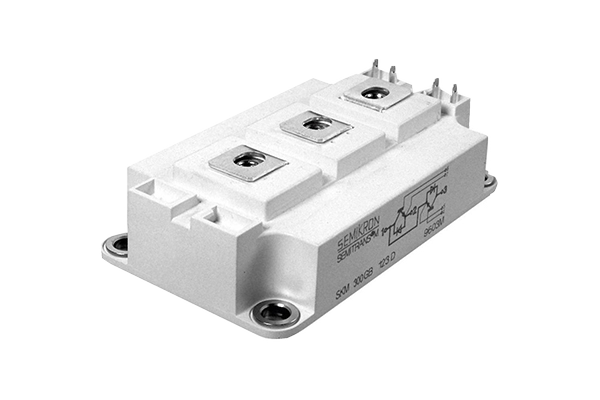
igbt transistor (insulated gate bipolar transistor) is the main cell element of modern inverters.
Features of igbt transistors
The frequency converter cell consists of a diode or thyristor rectifier – a capacitor, necessary to smooth out the ripples of the rectified voltage and approach the ideal form of direct current, and a power IGBT transistor – a switch. It can switch very quickly – up to 33,000 times per second (33 kHz), and still carry currents of up to 1000 amps.
The control and monitoring board generates control pulses for the inverter, receives external commands, issues feedback signals, and monitors the temperature and operating modes of all power elements.
Low and high voltage igbt transistors:
Until recently, all high-voltage frequency converters used only low-voltage igbt transistors (660V-690V). 6kV converters use 5 cells of 690V in each phase, connected in series, and 10kV converters use 8 cells per phase. Progress does not stand still, and more and more manufacturers are switching to high-voltage igbt transistors, which make it possible to significantly reduce the dimensions of the converter and abandon phase-shifting transformers.
Advantages of igbt transistors:
Powerful igbt transistors make it possible to build frequency converters for the largest drives, such as drives for boiler feed pumps, draft and grinding machines, and compressors. The Russian company CHEAZ is busy developing its own igbt transistors, introducing domestic igbt transistors to the market in an era of turbulent international relations. In the event of new sanctions, this will allow maintaining the production of frequency converters and promptly repairing existing drives, and will definitely always be in demand in the military industry.